Cute ugly animals include species such as the desert rain frog, quokka, and giant isopod, creatures whose odd proportions trigger the same nurturing instinct that makes humans coo over puppies and human babies. Big eyes, round bodies, and clumsy movements read as endearing even on an animal that would never win a beauty contest.

Scientists have a name for this reaction. It is the same wiring behind why a wrinkled, hairless creature can somehow look adorable instead of alarming, and why the internet keeps falling in love with animals nobody would call conventionally attractive.
This list covers 26 of the most lovable so-ugly-they’re-cute animals on Earth, complete with pictures, scientific names, and the specific traits that make each one work.
Why Do We Find Ugly Animals Cute?
Humans find odd-looking animals cute when their features trigger baby schema, an evolved response to big eyes, round bodies, and clumsy movement that signals something needs care.
Austrian ethologist Konrad Lorenz first described baby schema in the 1940s to explain why humans instinctively want to protect infants and puppies. The same visual triggers work on animals that are otherwise strange-looking, since a blobby body with oversized eyes reads as helpless rather than repulsive. In Japan, this specific reaction has its own name, kimo-kawaii, roughly translating to “creepy-cute,” describing an animal that seems off-putting at first glance but becomes endearing the longer someone looks at it.
What Makes an Animal “Ugly Cute” Instead of Just Ugly?
An animal reads as ugly cute when baby-like features, such as large eyes, a round body, or clumsy movement, sit on top of an otherwise unconventional or strange body shape.
A creature that is simply unusual, like a goblin shark, rarely gets called cute because nothing about it triggers a caregiving response. An animal that is genuinely cute-ugly usually combines one exaggerated baby-schema trait with an otherwise odd or homely appearance elsewhere on its body, creating the specific contrast that makes people want to look closer instead of looking away.
The World’s Cute Ugly Animals
The desert rain frog, quokka, and giant isopod rank among the most beloved cute ugly animals, each combining baby-like features with an otherwise unusual body.
Three-Toed Sloth
Large, round eyes set in a permanently sleepy-looking face give the three-toed sloth an expression that reads as gentle contentment even while it barely moves. Algae growing in its shaggy fur adds a greenish tint that only adds to its scruffy charm. Native to Central and South American rainforests, it moves so slowly that predators often overlook it entirely.
Desert Rain Frog
When threatened, the desert rain frog inflates its round, translucent body and lets out a high-pitched squeak that sounds almost exactly like a squeeze toy. Found only along a narrow strip of coastal desert in Namibia and South Africa, it spends most of its life burrowed in sand, emerging at night when coastal fog provides enough moisture to survive.
Emperor Tamarin
Named for its long, white, curling mustache said to resemble German emperor Wilhelm II, the emperor tamarin combines a tiny, wide-eyed face with an elaborate facial ornament that makes it instantly recognizable. This small primate lives in the treetops of the southwestern Amazon basin in groups that cooperatively raise offspring together.
Meerkat
A meerkat’s alert, upright posture and wide, dark-ringed eyes give it a permanently curious expression as it scans the horizon for predators. Living in tight-knit colonies across the deserts of southern Africa, meerkats take turns standing sentry duty while the rest of the group forages for scorpions and insects.

Giant Isopod
A deep-sea relative of the common pill bug, the giant isopod can grow over a foot long, and its ability to curl into a tight armored ball has made it a genuine pop culture icon in Japan, where it has been turned into plush toys and mascots. It scavenges on the ocean floor at depths exceeding 600 meters, sometimes surviving years without eating.
Panda Ant
Despite the name, the panda ant is actually a wingless velvet ant, a type of parasitic wasp covered in dense black and white fur that mimics the coloring of a giant panda in miniature. Found in Chile, it delivers one of the most painful stings of any insect relative to its size, a trait that clashes sharply with its adorable appearance.
Virginia Opossum
North America’s only marsupial, the Virginia opossum has a long, pointed snout, small beady eyes, and a hairless prehensile tail that together create an appearance many people find simultaneously unsettling and endearing. When threatened, it plays dead so convincingly that the behavior gave rise to the phrase “playing possum.”
Pug
Bred specifically for its flattened face and large, round, protruding eyes, the pug is one of the most recognizable brachycephalic dog breeds, with wrinkled skin folds that add to its expressive, almost cartoonish look. The breed originated in China and was historically kept as a companion animal for royalty.
Bat-Eared Fox
Enormous ears, nearly the size of the animal’s own head, give the bat-eared fox exceptional hearing used to locate termites and insect larvae underground across the grasslands of eastern and southern Africa. The oversized ears also help radiate excess body heat in hot climates.
Llama
A llama’s long banana-shaped ears, shaggy coat, and slightly protruding lower teeth combine into an expression many people describe as goofy rather than graceful. Domesticated in the Andes thousands of years ago, llamas were historically used as pack animals across steep mountain terrain where horses struggled to travel.

Brown Kiwi
A round, fluffy body paired with a long, drooping bill and nearly invisible wings gives the brown kiwi one of the most unusual silhouettes of any bird. Native to New Zealand, it is nocturnal and relies on a keen sense of smell, unusual for a bird, since its nostrils sit at the very tip of its bill rather than the base.
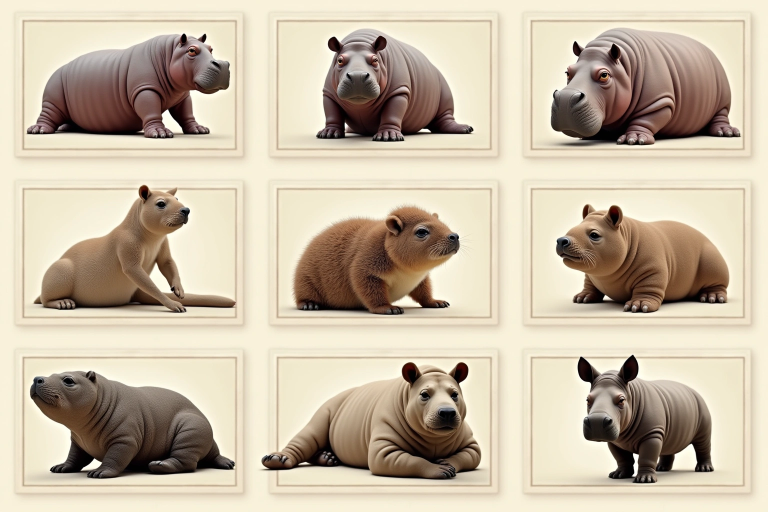
Pygmy Hippopotamus
A miniature, more solitary relative of the common hippo, the pygmy hippopotamus stands barely knee-high to its larger cousin and has proportionally larger eyes and a rounder head that give it a noticeably softer, more approachable look. Native to the forests of West Africa, fewer than 2,500 are estimated to remain in the wild.
Long-Eared Jerboa
Ears nearly the length of its entire body give the long-eared jerboa one of the most exaggerated silhouettes of any small mammal, paired with kangaroo-like hind legs built for powerful hopping across the deserts of Mongolia and China. It is almost never photographed in the wild due to its extreme rarity and nocturnal habits.
Chinese Crested Dog
Nearly hairless except for tufts on its head, feet, and tail, the Chinese crested dog has soft, wrinkled skin and large expressive eyes that give it a distinctly gremlin-like charm. The breed comes in both hairless and fully coated “powderpuff” varieties from the same litters.
Blue-Footed Booby
Bright blue webbed feet, the brighter the better for attracting a mate, give the blue-footed booby one of the most memorable looks of any seabird found along the Pacific coasts of Central and South America. Males perform an exaggerated high-stepping dance during courtship to show off their foot color.

Elephant Shrew
A long, flexible, trunk-like nose gives the elephant shrew a face that seems borrowed from a much larger animal, despite its body being roughly the size of a mouse. Native to Africa, it is more closely related to elephants and aardvarks than to true shrews, and it can run at surprising speed on long, thin legs.
Quokka
Often called the world’s happiest animal thanks to a facial structure that makes it appear to be permanently smiling, the quokka is a small wallaby found almost exclusively on islands off the coast of Western Australia. It has virtually no fear of humans, making it one of the most photographed animals on the internet.
Numbat
Reddish-brown fur marked with white stripes across the back gives the numbat a distinctive look among Australian marsupials, paired with a long, sticky tongue used to extract termites from mounds. Unlike most marsupials, it is active during the day and does not have a fully developed pouch.
Aardvark
A long, tubular snout, oversized rabbit-like ears, and a thick, hairless body give the aardvark one of the most instantly recognizable and oddly endearing profiles in the animal kingdom. Found across sub-Saharan Africa, it digs extensive burrow systems at night while foraging almost exclusively on ants and termites.

Mudskipper
Bulging eyes set high on top of its head let the mudskipper watch for predators even while its body remains buried in mud, and unlike most fish, it can survive out of water for extended periods by absorbing oxygen through its skin. Found across mangrove mudflats in Africa and Asia, it uses its fins to hop and skip across exposed mud at low tide.
Warty Frogfish
Covered in lumpy, irregular skin projections that mimic coral or algae, the warty frogfish uses camouflage rather than speed to ambush prey along coral reefs in the Indo-Pacific. Its oddly expressive, almost grumpy-looking face has made it a favorite subject among underwater photographers.
Pygmy Marmoset
The smallest true monkey species in the world, the pygmy marmoset can fit comfortably in a human palm and has a wide-eyed, round face that gives it an almost permanently startled expression. Found in the western Amazon basin, it feeds largely on tree sap, gouging small holes in bark with specialized teeth.
Basset Hound
Extremely long, droopy ears and heavily wrinkled facial skin give the basset hound one of the most mournful-looking expressions of any dog breed, despite its famously friendly, easygoing temperament. Originally bred in France for scent-tracking, its low body and long ears help stir up ground scent while hunting.
Red River Hog
Vivid reddish-orange fur, white facial markings, and long tufted ear hairs give the red river hog a strikingly colorful yet undeniably odd appearance among African wild pigs. Found in the forests and swamps of West and Central Africa, it is a strong swimmer and often forages in muddy river shallows.

Proboscis Bat
A small, elongated nose combined with tiny expressive eyes gives the proboscis bat, also called the sharp-nosed bat, a distinctly odd but endearing profile among Central and South American bat species. It roosts in small groups along tree trunks and riverbanks, relying on camouflage rather than caves for daytime shelter.
Sunda Colugo
Enormous reflective eyes adapted for nocturnal gliding give the Sunda colugo an unmistakably soulful expression, paired with a loose skin membrane that stretches between its limbs and tail, letting it glide over 100 meters between trees. Found in the rainforests of Southeast Asia, it is more closely related to primates than to any gliding rodent it resembles.

Readers who enjoyed the biology behind odd-looking animals should check out the weirdest animals in the world, several of which share a lot in common with this list. Fans of the more classically unattractive side of the animal kingdom will enjoy the ugliest animals on the planet, a list with far less baby-schema charm. Anyone drawn to unconventional body types should also browse the fat and ugly animals roundup for a different kind of lovable oddity. Conservation-minded readers can check the endangered animals list to see which cute-ugly species featured here need protection most. Finally, anyone curious where many of these creatures actually live can explore rainforest animals organized by the forest layer they call home.
Conclusion
Every animal on this list proves that ugly and adorable were never opposites to begin with. A desert rain frog’s squeak and a quokka’s permanent smile both hijack the same instinct that makes a human baby’s face irresistible, just wrapped around a body evolution never designed to be conventionally pretty.
The next time an odd-looking creature crosses a screen or a trail camera, it’s worth pausing before scrolling past. Somewhere between strange and adorable is exactly where most of these animals have been living all along.
Frequently Asked Questions
What is the cutest ugly animal in the world?
The quokka is frequently named the world’s cutest ugly animal thanks to a facial structure that makes it appear permanently smiling.
Why do humans find ugly animals cute?
Humans find ugly animals cute due to baby schema, an evolved response to big eyes, round bodies, and clumsy movement that triggers a caregiving instinct.
What does kimo-kawaii mean?
Kimo-kawaii is a Japanese term meaning creepy-cute, describing an animal that seems off-putting at first but becomes endearing the more it is observed.
What animal squeaks like a toy when scared?
The desert rain frog is famous for inflating its round body and squeaking loudly like a squeeze toy whenever it feels threatened.
Who first described baby schema?
Baby schema was first described by Austrian ethologist Konrad Lorenz in the 1940s to explain why humans instinctively want to protect infants and animals.
What deep-sea animal became a cute mascot in Japan?
The giant isopod, a deep-sea relative of the pill bug, has become a genuine pop culture icon in Japan, appearing as plush toys and mascots.
What is the smallest cute ugly primate?
The pygmy marmoset is the smallest true monkey species in the world and can fit comfortably in a human palm.
Are any cute ugly animals endangered?
Yes, several species on this list, including the pygmy hippopotamus and long-eared jerboa, face habitat loss and are considered threatened or rare.